




Introduction
If you own or manage a multi‑storey car park in Singapore, BCA periodic structural inspection (PSI) is one of the most important compliance obligations on your calendar. PSI is mandatory under the Building Control Act, and because multi‑storey car parks are classified as non‑residential buildings, they sit on a 5‑year inspection cycle once the structure reaches its 13th year of age. Ignore the notice and you risk fines up to SGD 20,000, prosecution, and-most critically-putting every driver, pedestrian and tenant using the car park at risk.
This article explains the entire periodic structural inspection PSI process in plain English, specifically for multi‑storey car parks. Whether you are an MCST council member, a commercial building owner, a town council officer, a JTC lessee, or an asset or facilities manager, the information here will help you understand exactly what BCA expects, what happens during inspections, and how to plan and budget so that compliance is smooth rather than stressful.
In short: when you receive a BCA PSI notice, you must appoint a registered professional engineer within two months, provide full access for inspection, act on any structural defects identified, and ensure the PSI report is submitted to BCA before the stated deadline.
Here is what you will learn:
-
When PSI applies to your car park and how the inspection frequency works
-
What the structural engineer actually inspects during Stage 1 and Stage 2
-
Your legal responsibility as the building owner-before, during and after PSI
-
Realistic timelines, PSI fees and practical planning tips for 2026
-
How Stellar Structures supports car park owners through the entire PSI process
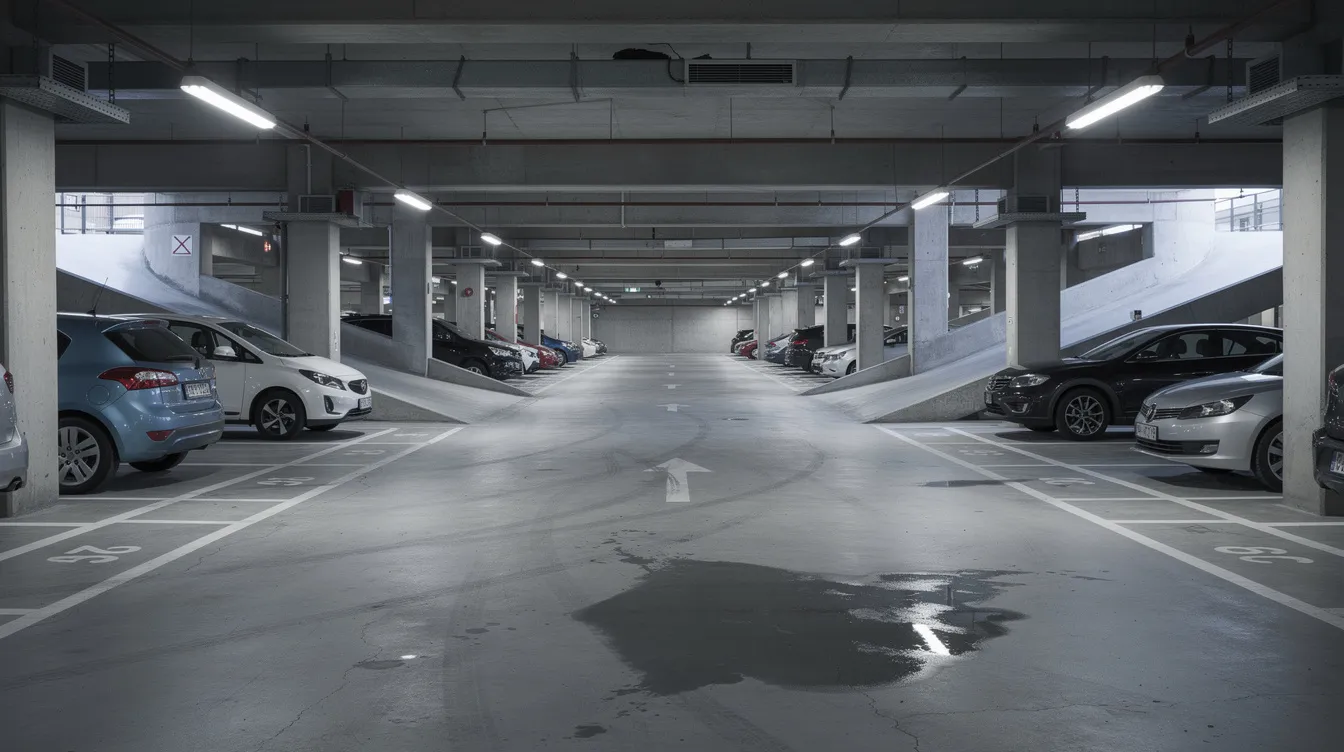
Understanding BCA PSI for Multi‑Storey Car Parks
Periodic structural inspection is, at its simplest, a scheduled structural health check ordered by the Building and Construction Authority. BCA focuses particularly on older multi‑storey structures that endure heavy vehicle use, constant dynamic loading, and direct exposure to Singapore’s tropical weather. Car parks require special attention for vulnerabilities like water seepage and thermal expansion-issues that can silently weaken concrete and steel over years.
PSI fits within Singapore’s broader building safety regime but is distinct from fire safety certification and the Periodic Façade Inspection (PFI) framework. While PFI deals with cladding, curtain walls and external finishes, PSI zeroes in on the primary load‑bearing structural elements that keep the building standing.
What “Periodic Structural Inspection” Really Means in Practice
Think of PSI as a scheduled “health check” for your car park’s skeleton-not a cosmetic review of paint, line markings or signage. The professional engineer examines the main structural elements: floor slabs, beams, columns, ramps, retaining walls and boundary walls to confirm they remain safe under normal and heavy vehicle loads.
For multi‑storey car parks, PSI is mandatory for buildings 13 years or older. Multi-storey car parks require PSI every 5 years, with BCA issuing formal PSI notices to building owners. The PSI process includes a Stage 1 visual inspection of all accessible structural elements. Stage 2 investigations occur if Stage 1 identifies defects that raise structural concerns requiring further investigation, including material testing and structural calculations.
It is also important to understand that the PSI is not a substitute for routine maintenance inspections of the building. Structures require ongoing maintenance between PSI cycles to prevent undetected issues from developing into serious safety risks.
How Multi‑Storey Car Parks Differ from Other Buildings Structurally
Multi‑storey car parks are structurally unique compared to enclosed office or residential floors. Their open sides expose concrete to rain, humidity, vehicle exhaust and-in coastal areas-salt‑laden air. Multi-storey car parks experience continuous dynamic and cyclical loading from vehicles, including turning stresses on ramps, braking forces on decks, and occasional impact from oversized vehicles.
Typical structural systems in Singapore car parks include reinforced concrete flat slabs, precast systems, post‑tensioned beams and steel crash barriers. These elements age differently from a climate‑controlled office floor. Concrete carbonation rates in Singapore range from 5.5 mm to 8.6 mm per year, which means reinforcement corrosion can begin much earlier than many owners expect, particularly where concrete cover is thin.
BCA’s stricter focus on water ingress, corrosion and impact damage during PSI for car parks directly reflects these realities. Understanding these structural basics helps owners appreciate why the regulatory rules and inspection frequency are specific for car parks.
Regulatory Rules for Multi‑Storey Car Park PSI (Plain English Guide)
Now that the structural context is clear, this section translates the key BCA rules into easy‑to‑follow points specifically for multi‑storey car parks. The primary legislation is Section 28 of the Building Control Act and the Building Control (Periodic Inspection of Buildings and Building Façades) Regulations, but the focus here is on what these rules mean practically for you.
Which Car Parks Must Undergo PSI – Scope and Frequency
Buildings must undergo PSI from their 13th year of age. The PSI notifies owners approximately 12 months before inspection deadlines, giving you time to prepare. Non-residential buildings are inspected every 5 years after 13 years, and residential buildings require inspection every 10 years-so if your car park serves a commercial, industrial, or mixed‑use development, expect the shorter 5‑year PSI cycle.
Car parks attached to malls, offices, industrial buildings, HDB estates managed by town councils, or JTC‑leased properties are generally classified as non‑residential buildings and follow the 5‑year inspection frequency. Small ancillary parking at purely residential landed houses (detached, semi detached and linked houses) is generally exempt, but integrated podium car parks in condominiums and strata titled developments fall squarely under the MCST’s PSI responsibility.
BCA can also request earlier or more frequent periodic inspection if there are public complaints, visible structural issues such as severe spalling concrete, ponding water, or reports of impact damage.
Who is Considered the “Owner” for PSI Purposes?
Legal duties for PSI compliance rest with the building owner or MCST. In practical terms:
-
For strata titled developments, the management corporation (MCST) is the legally responsible party for common property car parks
-
For stand‑alone commercial properties, the private title holder is the owner
-
For JTC‑leased industrial premises, the JTC lessee bears the legal responsibility
-
For HDB multi‑storey car parks, the relevant town council or HDB itself is the owner
Even if a managing agent or facilities management company handles day‑to‑day building management, the owner entity remains legally responsible for missed deadlines and non‑compliance. You can delegate coordination to your facility manager, but you cannot delegate liability.
Key PSI Deadlines and Documents You’ll See
A typical BCA PSI notice for a multi‑storey car park contains the building address, its classification (non‑residential), the due date for inspection, and the submission deadline for the final inspection report.
The typical timeline works as follows: building owners must appoint a structural engineer within 2 months of receiving the BCA notice and inform BCA of the appointment. Owners must submit the inspection report to BCA within 6 to 12 months, depending on building size and complexity. If Stage 2 is triggered, the timeline may extend, but BCA expects proactive communication.
Official submissions are made by the professional engineer via CORENET‑X or the relevant BCA platform. Owners should retain signed copies for their internal records, insurance files and future PSI cycles.
What Happens During a Multi‑Storey Car Park PSI
The PSI process is systematic and predictable when planned early. There are two main stages, and most car parks only require Stage 1 unless the engineer discovers specific structural concerns that warrant deeper investigation.
Stage 1: Visual Structural Inspection of the Car Park
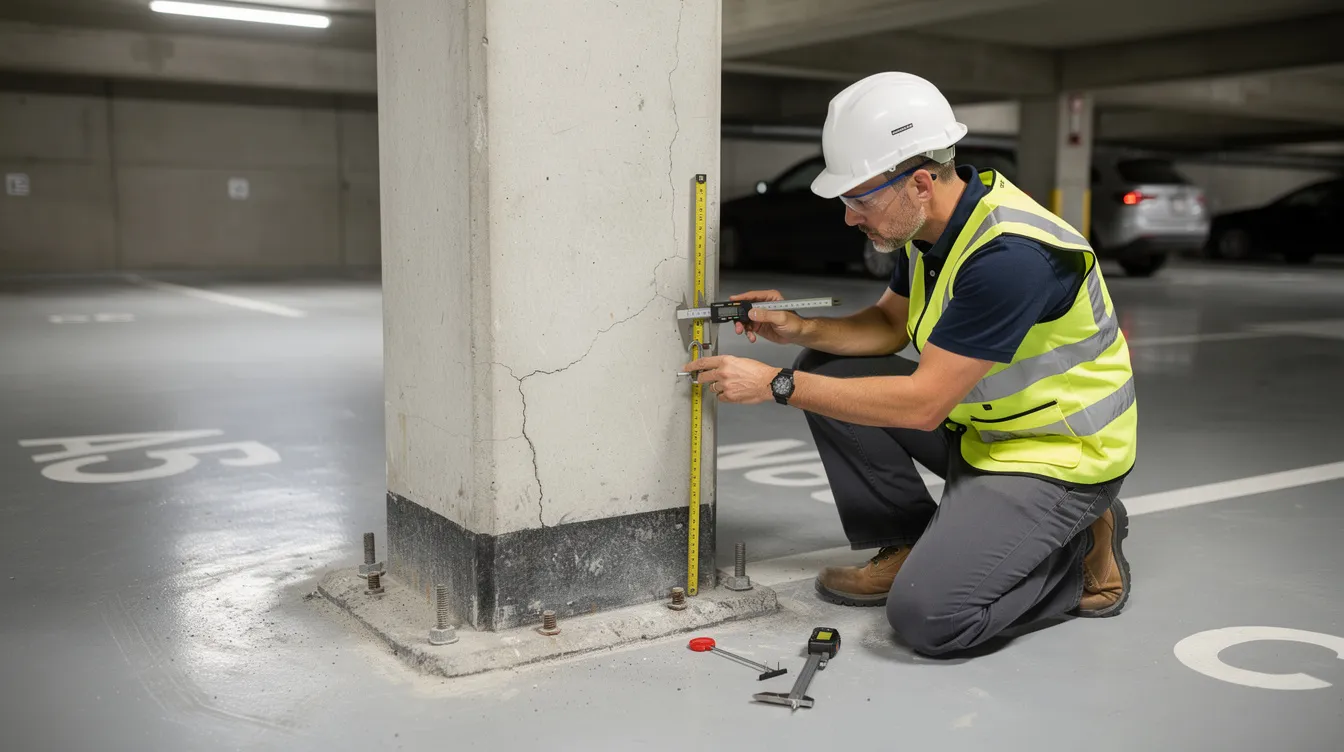
Stage 1 is a thorough walk‑through and close visual inspection of all accessible structural elements, conducted personally by the appointed professional engineer. Visual inspections assess cracks, deflections, dampness, and water ponding on structural elements throughout the car park.
Key areas inspected in a multi‑storey car park include:
-
Entry and exit ramps, including helical ramps
-
Intermediate deck slabs and roof deck surfaces
-
Column lines, particularly those at corners and ramp entries
-
Beams, transfer beams and soffits
-
Movement and expansion joints
-
Planter boxes situated above car park levels
-
Retaining walls and basement perimeters
-
Boundary walls and edge beams
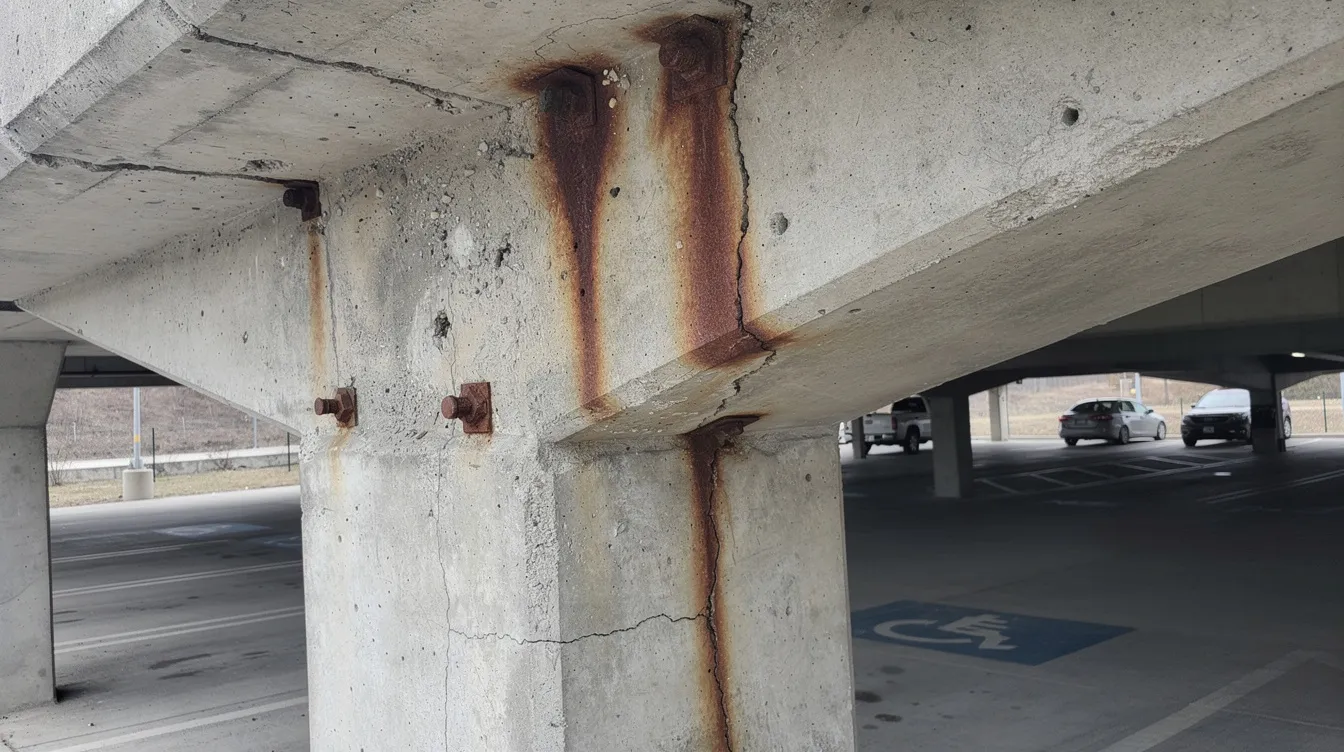
The engineer looks for visible cracks, sagging or deflected slabs, rust marks and corrosion staining, spalling concrete (where chunks flake or fall away), water leaks, exposed reinforcement bars and ponding water. Common defects include concrete spalling and longitudinal cracking in beams-both indicators that reinforcement corrosion may be active.
Stage 1 concludes with a formal report. The outcome is either “no further detailed investigation needed” or “Stage 2 recommended for specific areas.”
Stage 2: Detailed Tests and Calculations (When Required)
If severe defects are found, a more rigorous investigation is required, including material testing. Stage 2 investigations occur if Stage 1 identifies defects such as major cracking, significant corrosion, suspected overloading, or unusual deformation.
Typical Stage 2 tests, described in plain English:
-
Concrete core sampling: small cylinders drilled from the structure to test concrete strength and carbonation depth in a laboratory
-
Covermeter scans: electromagnetic devices that locate reinforcement bars and measure how much concrete protects them
-
Half‑cell corrosion tests: electrical readings that indicate whether reinforcement is actively corroding
-
Loading assessment: structural calculations to confirm whether the car park can safely carry its current and anticipated vehicle loads, particularly on heavily used ramps
Some tests require temporary closures of certain bays or ramps and may involve small drilling or removal of finishes. The PE will carry out structural calculations based on current use and issue recommendations ranging from monitoring to strengthening or partial closure.
What the PE Focuses On in Car Parks (Checklist‑Style)
Here is a plain‑English checklist of the visible structural elements and areas a professional engineer prioritises during car park PSI:
-
Deck slabs: cracks, ponding water, spalling concrete, deflection
-
Beams and transfer beams: shear cracks, deflection, rust staining at soffits
-
Columns: particularly those at impact zones, corner bays and ramp edges where impact damage to columns often occurs at corners and ramp entries
-
Ramps and helical ramps: slip surfaces, cracking, joint details, drainage
-
Retaining walls and basement structures: water leaks, movement, efflorescence
-
Edge beams and crash barriers: impact damage, corrosion of steel connectors and barrier posts (a common issue in ageing car parks)
-
Movement joints: sealant failure, debris blockage, differential settlement
Every one of these elements directly affects the safety of users and vehicles. Understanding what the PE checks helps owners prepare access and anticipate findings.
Owner Responsibilities Before, During and After PSI
PSI is a shared effort between the building owner, the appointed PE and the facilities team, but the legal duties clearly sit with the owner. This section reads as a practical to‑do guide for MCSTs, town councils and private owners.
Before Inspection: Planning and Appointment of PE
Your first step is to appoint a qualified structural engineer-specifically a Professional Engineer (Civil/Structural) registered with the Professional Engineers Board (PEB). Professional Engineers must hold a valid practising certificate, and the appointed engineer must not have conflicting commercial interests in relation to the building being inspected.
Documents and information to prepare for the PE:
-
As‑built structural drawings (if unavailable, flag this early as reconstruction takes time)
-
Past PSI reports and any previous inspection findings
-
Records of major structural repairs, waterproofing renewals or alterations
-
Leak logs, ponding complaints and accident reports involving columns or barriers
-
Current usage details (e.g. heavy vehicle access, storage areas, any unauthorised modifications)
For MCSTs managing large estates with podium car parks, early budgeting is essential. MCST AGM or EGM approvals may be needed to allocate funds for PSI fees, so factor in lead time. Stellar Structures can help review your BCA notice and confirm the scope before formal engagement.
During Inspection: Access, Safety and Minimising Disruption
Owners must provide access for the structural engineer’s inspection across all critical areas. Practical steps include:
-
Reserving parking lots adjacent to inspection zones
-
Posting signage to warn users of ongoing inspection works
-
Preparing temporary diversion plans for ramps or levels under inspection
-
Providing or allowing safe access equipment such as mobile elevated work platforms (MEWPs), ladders or scaffolding
Coordinate with security, cleaning teams and tenants for nighttime or off‑peak psi inspections to achieve minimal disruption to shoppers, residents or warehouse operations. Importantly, do not block access to plant rooms, locked service areas or concealed spaces that may contain critical structural elements-the PE needs to inspect these as well.
After Inspection: Acting on the Report and Closing the Loop
Engineers prepare formal reports on structural integrity after inspections. The PSI report will classify structural defects by urgency:
-
Immediate safety defects: require urgent remedial works (e.g. loose spalling concrete overhead, severely corroded crash barriers)
-
Medium‑term repairs: should be addressed within a defined period, typically before the next PSI cycle
-
Monitor items: minor issues logged for observation during routine maintenance and the next periodic structural inspection
Owners must implement recommended repairs within suggested timeframes, appoint suitable contractors, and have the PE verify critical structural repairs. The final PSI report-and any supplemental confirmation if Stage 2 or remedial works were required-must be submitted to BCA before the deadline. Owners must submit the PSI report to BCA within deadlines to avoid enforcement action.
Keep all reports and photographs in a central digital archive. These records are invaluable for future PSI cycles, insurance renewals, transaction due diligence and board reporting.
Common Structural Problems in Multi‑Storey Car Parks and How PSI Helps
Singapore’s humid, coastal tropical climate creates a harsh environment for car park structures. PSI is designed to catch recurring issues early, well before they become safety risks or costly emergencies.
Water Leaks, Ponding and Concrete Spalling
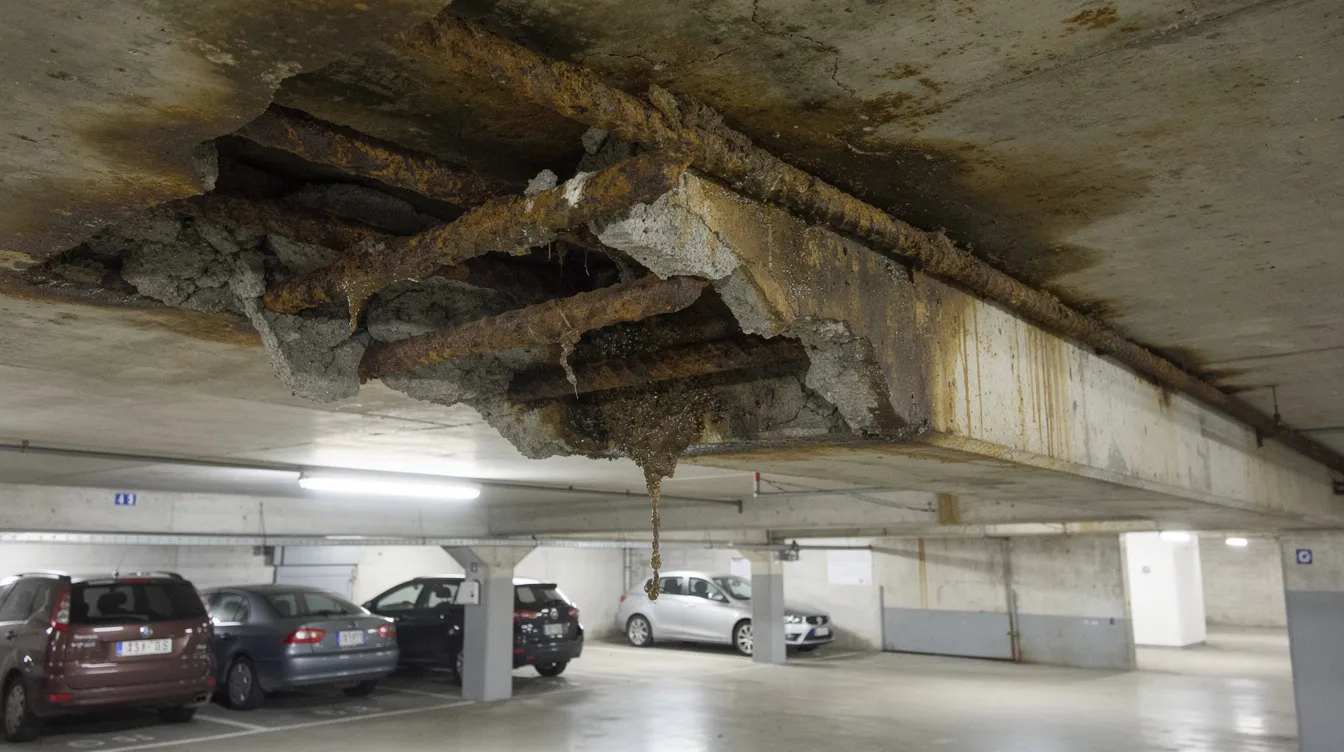
Water ingress from failed waterproofing accelerates structural deterioration. Chronic leaks from upper decks and planter boxes cause concrete to crack and reinforcement to rust, particularly at joints and around drainage outlets. Over time, concrete spalling begins-chunks of concrete flake off, exposing corroded rebar and posing a direct falling hazard to vehicles and pedestrians below.
PSI highlights exactly where waterproofing has failed, where ponding water is accumulating, and where spalling has begun, so owners can plan repairs before serious harm occurs. A 2026 BCA property condition audit of pre‑1990 HDB blocks found spalling in over 38% of inspected multi‑storey car parks and external corridor slabs-evidence that degradation is widespread, not rare, in older structures.
Corrosion and Deterioration in Coastal or Industrial Areas
Car parks near the sea, expressways, or industrial zones face higher chloride exposure and exhaust fume concentration, accelerating corrosion of reinforcement steel and post‑tensioning strands. PSI for such locations typically involves more detailed attention to lower decks, basement walls and areas close to expansion joints.
Regular PSI cycles, combined with protective coatings, improved drainage and timely structural repairs, demonstrably extend the service life of these structures. The structural condition of a well‑maintained coastal car park after 30 years can be markedly better than a neglected inland car park of the same age.
Impact Damage, Overloading and Unauthorised Modifications
Common operational issues in car parks include trucks hitting soffits, vehicles striking columns and crash barriers, and owners converting parking bays into storage for heavy pallets or equipment. Impact damage to columns often occurs at corners and ramp entries where vehicles misjudge turning radii.
PSI flags significant impact damage and misuse-particularly overloading beyond the original design capacity-so owners can carry out repairs and enforce proper use policies. Structural alterations such as hacking beams or creating new openings without PE design and BCA approval will be identified during inspection and must be regularised.
Costs, Timelines and Practical Planning for Car Park PSI
Understanding typical PSI fees and timelines helps owners budget confidently and schedule the inspection process without panic when a BCA notice arrives.
Typical Fees for Multi‑Storey Car Park PSI (Indicative 2026)
Based on current market data for Singapore in 2026, here are indicative professional fees for car park PSI:
-
Small podium car park in a condo (up to 3 levels, under 200 lots): S$4,000 – S$7,000 for Stage 1
-
Mid‑size commercial/office car park (4–6 levels, 200–500 lots): S$7,000 – S$12,000
-
Large stand‑alone or mall car park (7+ levels or over 500 lots, including basements): S$12,000 – S$25,000+
Key cost drivers include the number of decks and ramps, basement levels, access difficulty, availability of structural drawings, and whether Stage 2 is anticipated. Detailed Stage 2 investigations, laboratory testing and finite element analysis are quoted separately and can be significant, especially if extensive deterioration is found. For a deeper breakdown, see our guide on how much a BCA periodic structural inspection costs in 2026.
How Long the PSI Process Usually Takes
A typical timeline from engagement to final report preparation and submission for a multi‑storey car park:
-
Engagement and planning: 2–4 weeks for large estates; shorter for smaller car parks
-
On‑site Stage 1 inspection: usually 1–5 days depending on size and phasing to reduce disruption
-
Report preparation and BCA submission: 2–4 weeks after inspection, longer if Stage 2 or laboratory tests are required
-
Stage 2 investigations (if triggered): additional 4–8 weeks depending on test types and laboratory turnaround
We recommend starting engagement 6–12 months before BCA’s submission deadline. This buffer allows for potential Stage 2 investigations and any urgent remedial works that might be discovered during inspection.
Integrating PSI with Maintenance and Car Park Operations
Smart owners combine PSI with scheduled repainting, waterproofing renewals and M&E upgrades to minimise repeated closures and achieve better value from contractor mobilisation. Use PSI findings to prioritise capital works over a 5–10 year window, especially for ageing estates with frequent leaks.
Creating a simple internal register of defects and repair dates ensures the next PSI cycle is smoother and cheaper. This register also demonstrates to BCA and insurers that the building is being properly maintained between fixed intervals.
Legal and Commercial Consequences of Poor PSI Compliance
PSI is not merely a paper exercise. BCA, insurers, financiers and tenants all scrutinise car park safety and compliance status in 2026.
Penalties and Enforcement by BCA
Failure to comply with PSI requirements can lead to significant penalties under the Building Control Act. PSI is mandatory under the Building Control Act, and non‑compliance can lead to fines up to SGD 20,000. Failure to appoint a structural engineer can result in imprisonment in serious cases. Prosecution can occur for repeated late filings of PSI reports, and BCA can issue enforcement notices requiring immediate action, including closure of unsafe decks or ramps until structural inspections and repairs are completed.
The typical enforcement sequence runs from reminder letters, to formal directions, to legal penalties, and ultimately to forced closure. Co‑operating early, demonstrating a clear compliance plan, and engaging a competent PE can significantly reduce enforcement escalation.
Engineers bear personal civil and criminal liability for inspection findings, which is precisely why BCA requires the appointed PE to conduct the visual inspection personally-this cannot be wholly delegated to assistants.
Impact on Insurance, Financing and Asset Value
Insurance complications may arise from non-compliance with PSI. Insurers may query or limit coverage if your car park’s PSI status is overdue or reports show unaddressed safety defects. During refinancing or sale of commercial properties, banks and potential buyers increasingly check PSI status and structural reports.
A clean PSI record and completed remedial works support stronger property valuations and smoother transactions. Conversely, outstanding enforcement notices or unresolved structural defects can materially reduce an asset’s market value.
Risk to Users and Brand Reputation
The real‑world risks of neglected car park structural safety include falling concrete, ramp failures and closed decks-all causing operational disruptions and reputational damage for malls, hotels and industrial estates. Visible safety lapses such as taped‑off spalling areas and water‑stained soffits erode public safety confidence and can attract significant social media attention.
PSI functions best as a proactive governance tool rather than a last‑minute scramble triggered by visible failures or public complaints.
How Stellar Structures Supports Multi‑Storey Car Park Owners with PSI
Stellar Structures is a Singapore‑based engineering and architectural consultancy providing end‑to‑end BCA periodic structural inspection and related services for infrastructure assets, including multi‑storey car parks of all sizes and building types.
Our Role as Your PE Partner
Stellar Structures works with PEB‑registered Professional Engineers (Civil/Structural) experienced in reinforced concrete car parks, podium decks and basements. Our key services include:
-
Stage 1 PSI visual inspections for all car park configurations
-
Stage 2 investigations including concrete core sampling, covermeter scans and half‑cell corrosion tests
-
Structural analysis for ramps, transfer beams and loading assessment
-
BCA/CORENET‑X submissions and liaison with the construction authority
-
Reports written in clear, non‑jargon English with photographs and defect maps
Our reports are designed to help MCSTs and asset managers communicate findings effectively to councils, boards and stakeholders.
Coordinating PSI, Repairs and Authority Submissions
Stellar Structures integrates PSI findings with design for strengthening works, waterproofing detailing, and A&A submissions to BCA, URA, JTC and SCDF where needed. We provide project management support: scheduling inspections around peak hours, coordinating with contractors, and staging works to keep most car park levels operational throughout.
We also advise on long‑term maintenance planning and budgeting for car park structural upgrades, helping owners move from reactive patching to planned capital expenditure.
Visual Documentation and Digital Records
Stellar Structures uses clear photographs, annotated drawings and, where helpful, 3D/BIM models to document defects and repair scopes. Clients receive both official BCA‑ready PSI reports and an internal summary version highlighting actionable points and timelines for management meetings.
We encourage owners to treat PSI outputs as reusable assets for future structural inspections, insurance renewals and property audits-not just one‑off compliance paperwork.
Common Owner Questions and Practical Answers (FAQ)
This FAQ is written in plain English and addresses the issues most frequently raised by multi‑storey car park owners and MCSTs in Singapore.
Is PSI for my multi‑storey car park really mandatory if it “looks fine”?
Yes. If the building meets the age criteria and BCA issues a PSI notice, periodic structural inspection is mandatory regardless of how the car park appears. Hidden structural defects inside concrete or behind finishes-such as corroding reinforcement or carbonation‑weakened zones-may not be visible to the untrained eye. BCA data from 2023–2025 shows that out of more than 7,000 buildings inspected annually, over 600 had defects serious enough to warrant remedial works, even though 91% showed no major external signs of distress.
How do I know if my car park is on the 5‑year or 10‑year inspection cycle?
Periodic structural inspections are mandatory every 5 years for non-residential buildings. Multi‑storey car parks attached to commercial, industrial or mixed‑use residential developments are almost always on the 5‑year cycle. Purely residential buildings follow 10‑year cycles, but their common‑property podium car parks may still be classified as non‑residential. Check your BCA notice classification or consult a PE if you are unsure about the correct PSI cycle for your building.
Can my facilities contractor or in‑house engineer do the PSI instead of a PE?
No. BCA requires a registered professional engineer (Civil/Structural) registered with the Professional Engineers Board with a valid practising certificate to conduct and sign the PSI report. In‑house engineers, maintenance contractors or facilities teams can support the process-providing access, drawings and historical data-but they cannot replace the PE’s statutory role. The appointed PE must personally conduct the visual inspection.
What if we cannot complete repairs before the BCA deadline?
Owners should still ensure the PSI report is submitted on time, clearly documenting that structural defects have been identified and a repair programme is in place. Engage the PE to help prioritise urgent works and, if necessary, communicate proactively with BCA with a realistic remedial works schedule. Demonstrating a clear plan significantly reduces enforcement risk.
How soon should we start planning PSI after receiving a BCA notice?
Engage a PE as soon as the PSI notice arrives. For large car parks, start planning 9–12 months before the submission deadline. This buffer allows for Stage 2 investigations, laboratory turnaround, and any urgent structural repairs that might be discovered. Smaller car parks can typically work within a 6‑month window, but earlier engagement always reduces risk.
Does PSI cover façade elements of the car park as well?
PSI focuses on primary load‑bearing structural elements-slabs, beams, columns, ramps and retaining walls. External façade elements such as cladding, screens and decorative panels fall under the separate Periodic Façade Inspection (PFI) regime in Singapore. Stellar Structures provides both structural and façade safety inspections for clients who want a combined review, ensuring nothing falls between the two regulatory frameworks.
Conclusion and Next Steps
BCA periodic structural inspection for multi‑storey car parks is mandatory, manageable and a key part of protecting both public safety and asset value. The PSI regime exists because car parks face unique structural stresses-from constant vehicle loading to water ingress and corrosion-that demand regular professional scrutiny. With proper planning, the inspection process is straightforward and delivers lasting benefits far beyond compliance.
Your immediate next steps:
-
Locate and review any BCA PSI notices for your car park
-
Check the age and classification of your car park to confirm its PSI cycle and inspection frequency
-
Gather structural drawings and past reports into a central folder
-
Ensure your building structures are being properly maintained between inspection cycles
-
Reach out to a PEB‑registered PE or Stellar Structures for a preliminary consultation and fee proposal
You may also wish to explore related topics such as BCA Periodic Façade Inspection for car park façades, Singapore’s statutory periodic building inspection frameworks, or how to integrate structural PSI findings with your overall building asset management strategy.